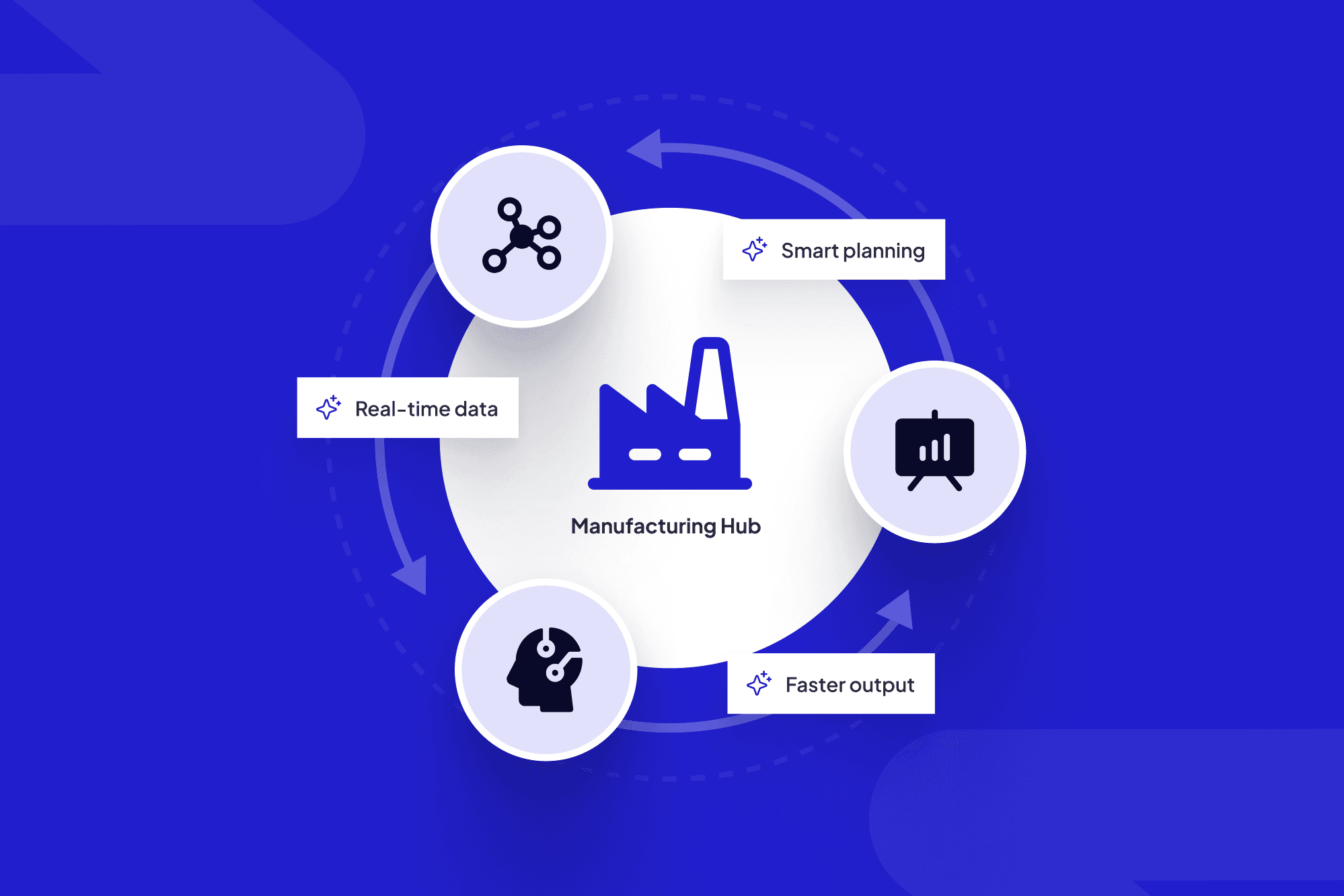
Digital transformation in manufacturing isn’t about replacing workers with robots. It’s about connecting people, machines, and data so production becomes smarter, faster, and more efficient.
In simple terms, it’s the move from manual, paper-based operations to a fully connected digital ecosystem, where machines talk to each other, analytics predict problems before they happen, and decisions are made using real-time insights rather than guesswork.
At its core, digital transformation modernizes how manufacturers:
Design and prototype products
Manage supply chains
Track quality and maintenance
Forecast demand and allocate resources
This shift is often called Industry 4.0, and it represents the most significant evolution in manufacturing since the assembly line. Instead of operating in silos, every part of production, from procurement to delivery, becomes interconnected. The outcome? Less downtime, better productivity, and faster responses to customer demand.
Why Manufacturers Are Prioritizing Digital Transformation
Manufacturing has always been about efficiency, but today’s challenges demand more than just tighter schedules or leaner teams. The industry faces a new reality shaped by global supply disruptions, rising labor costs, and sustainability pressures.
Here’s what’s driving the change:
Rising Competition and Price Pressure
Manufacturers operate in a global market where margins are thin. To compete, they need real-time data to optimize production costs and reduce waste. Digital tools make that possible, giving them insight into everything from energy use to supplier performance.
Supply Chain Volatility
Disruptions can stall operations overnight. By connecting suppliers, logistics, and production through digital platforms, manufacturers gain visibility into each link of their chain — identifying issues before they cause bottlenecks.
Evolving Customer Expectations
Buyers now expect faster delivery, personalized products, and transparent processes. Digital transformation makes this feasible through custom production systems, on-demand scheduling, and automated quality tracking.
Sustainability and Compliance
Environmental responsibility isn’t optional anymore. Digital tracking helps manufacturers measure carbon emissions, monitor energy usage, and comply with sustainability standards.
In short, digital transformation helps manufacturers survive now and scale later. It’s not just about doing things faster; it’s about building an operation that can adapt, recover, and grow through uncertainty.
Core Pillars of Digital Transformation in Manufacturing
Successful transformation doesn’t happen overnight. It’s built on a foundation of technologies and processes that work together. Here are the four core pillars every manufacturer needs to understand:
Connectivity (IoT and Sensors)
Machines and production lines are now connected through the Internet of Things (IoT), utilizing sensors that continuously collect and share data on temperature, vibration, pressure, and performance.
Maintenance teams get instant alerts before failures happen.
Production planners can monitor line efficiency in real time.
Executives can track plant performance from anywhere.
Connectivity forms the nervous system of a modern factory. Without it, digital transformation simply can’t function.
Automation and Robotics
Automation isn’t just for high-end factories. It’s used everywhere — from robotic assembly arms to automated quality control systems. Benefits include:|
Reduced labor dependency for repetitive tasks
Higher precision and consistency
Better safety in hazardous environments
Automation improves both speed and accuracy while freeing human workers to focus on high-value work like design, supervision, and innovation.
Data Analytics and AI
Raw data is powerful only when it’s analyzed. Manufacturers now rely on machine learning and analytics platforms to identify inefficiencies, predict demand, and optimize output. Examples include:
Predictive maintenance powered by AI-based fault detection
Real-time dashboards that track yield and defect rates
Demand forecasting models that reduce excess inventory
The more a company learns from its data, the smarter and leaner its operations become.
Cloud and System Integration
Legacy systems often trap valuable data in isolated silos. Moving operations to the cloud connects everything, from ERP and CRM systems to warehouse and supplier networks.
Teams get instant access to accurate information
Updates sync automatically across departments
New tools and features can be added without infrastructure overload
In the end, these four pillars, connectivity, automation, analytics, and integration, form the backbone of every modern manufacturing transformation strategy.
Examples of Digital Transformation in Manufacturing
While “digital transformation” can sound abstract, it’s already reshaping real factories across the world. Here are some practical examples that show how modern manufacturers are applying these changes:
a. Predictive Maintenance Using IoT
In traditional plants, maintenance happens reactively; a machine breaks down, and production stops. With IoT sensors and predictive analytics, maintenance becomes proactive. Machines now send real-time alerts when parts show signs of wear or abnormal vibration. This minimizes downtime and saves thousands in repair costs.
Example: A mid-size automotive parts manufacturer in Germany reduced machine downtime by 40% after installing IoT-based predictive maintenance systems connected to their ERP dashboard.
b. Smart Factory Automation
Smart factories use robotics, AI, and connected systems to automate production from start to finish. Every machine communicates with the next, adjusting speeds or resource use automatically to maintain output quality.
Example: A U.S. electronics manufacturer automated its assembly line and used AI to detect product defects in real time. Within six months, they cut human error by 60% and increased daily throughput by 25%.
c. Digital Twin Technology
A digital twin is a virtual copy of a physical asset — like a machine or entire production line. Engineers use it to test new settings or detect inefficiencies before applying them in real life.
Example: A global aerospace company uses digital twins to simulate factory workflows and identify bottlenecks. These simulations save them millions in energy and production time each year.
d. Additive Manufacturing (3D Printing)
3D printing is revolutionizing how prototypes and replacement parts are produced. Instead of waiting weeks for suppliers, manufacturers can print components on demand, cutting lead times and costs dramatically.
e. Supply Chain Automation
Manufacturers now use cloud-based portals that connect suppliers, inventory, and logistics in one place. When raw material levels drop, the system automatically sends purchase orders to pre-approved vendors.
All these examples prove one thing: digital transformation isn’t about “future technology.” It’s already happening, and those who adapt early are gaining a serious competitive edge.
Key Benefits: From Efficiency to Sustainability
Once digital systems are in place, the benefits compound fast, touching every layer of the organization.
Here’s how manufacturers measure impact:
Benefit Area | Before Digital Transformation | After Digital Transformation |
Downtime | Unplanned, frequent machine failures | Predictive maintenance reduces breakdowns by 30–50% |
Production Speed | Manual approvals, slower throughput | Automated workflows speed up operations |
Quality Control | Random sampling and human checks | AI-driven inspection ensures near-zero defects |
Cost Efficiency | High waste and rework | Leaner resource use and precise production planning |
Sustainability | Limited tracking, higher energy use | Real-time monitoring and waste reduction |
Decision Making | Reactive and manual | Data-driven insights across the factory floor |
Additional Competitive Advantages
Faster time-to-market: Digital prototyping shortens product development cycles.
Better customer satisfaction: Real-time visibility enables on-time delivery.
Employee satisfaction: Teams focus on problem-solving rather than repetitive paperwork.
Operational resilience: Automation keeps production stable even during labor or supply disruptions.
The end result? A factory that’s smarter, leaner, and greener, and far more responsive to market shifts.
Challenges and Roadblocks Manufacturers Face
Of course, transformation doesn’t come without hurdles. Many manufacturers struggle not because the technology fails, but because the implementation plan doesn’t align with real-world workflows.
Here are some common challenges:
Legacy Systems and Equipment
Old machines often don’t support modern sensors or software integration. Upgrading or retrofitting them can be costly, and interoperability remains a major pain point for many factories.
Data Silos
When departments use different tools, accounting, production, maintenance, data stays fragmented. Without a unified system, insights get lost and duplication increases.
Resistance to Change
Operators and supervisors accustomed to manual processes often hesitate to trust automation or analytics tools. Successful transformation depends heavily on leadership communication and training.
Skill Gaps
Many workers lack digital literacy or data analysis experience. Companies must invest in upskilling programs to help teams adapt to new tools confidently.
Implementation Cost
While the ROI is strong long-term, initial investments can be high. Cloud migration, new hardware, and training programs require careful budgeting and phased rollouts.
How Leading Manufacturers Overcome These
Start small — pilot projects first, scale after success.
Choose integrations over replacements — retrofit machines when possible.
Focus on employee buy-in — involve operators early in design.
Use partners that understand both manufacturing and software (like ScaleLabs).
Step-by-Step Roadmap for Implementing Transformation
Going digital isn’t a switch you flip. It’s a structured journey that works best when rolled out in stages, each one proving its value before scaling further.
Here’s a simple five-stage roadmap most successful manufacturers follow:
Assess and Map Existing Processes
Start by identifying which parts of your operations cause the most delays or errors.
Ask:
Where do approvals slow down?
What tasks are repetitive and manual?
Which departments lack data visibility?
This baseline helps you see which processes will benefit most from automation or integration.
Define Measurable Goals
Transformation must have clear outcomes, like reducing downtime by 20% or improving production tracking accuracy. These KPIs guide your decisions and justify investments to stakeholders.
Start with Pilot Projects
Begin small. Automate a single workflow, for example, predictive maintenance or production scheduling. Once proven, extend automation to related areas like inventory control or procurement. This limits risk while showing tangible ROI.
Integrate Systems and Data
Data silos block growth. Connect ERP, CRM, maintenance systems, and supplier networks into one ecosystem. Cloud-based platforms make this easy, ensuring everyone, from floor operators to managers, sees the same real-time information.
Train, Monitor, and Improve Continuously
No transformation succeeds without people. Train employees to use new dashboards, read data insights, and make decisions faster. Keep gathering feedback and optimizing workflows every quarter.
When executed with structure and patience, these five steps transform not just technology, but how your factory operates day to day.
The Future of Manufacturing: AI, Automation, and the Human Role
Digital transformation doesn’t replace people, it empowers them. The next evolution, often called Industry 5.0, blends automation with human creativity.
Here’s what’s coming:
AI copilots for production teams: Suggest optimal machine settings or maintenance schedules automatically.
Digital twins for supply chains: Real-time simulation of suppliers, logistics, and inventory to predict risks.
Sustainable smart factories: Data-driven energy optimization and waste reduction at scale.
Collaborative robots (“cobots”): Working safely beside humans to handle precision tasks.
In this new era, humans provide judgment, innovation, and oversight, while automation handles repetition. The factories of tomorrow won’t just make products faster; they’ll make better decisions every second.
Conclusion: From Factory Floor to Digital Ecosystem
Digital transformation in manufacturing is not about adding tech for the sake of it; it’s about building a connected, intelligent ecosystem. When machines, systems, and people work in sync, efficiency follows naturally.
At ScaleLabs, we help manufacturers design custom automation portals and data-driven workflows that connect production, procurement, and analytics into one streamlined platform. Whether it’s automating maintenance, integrating vendor data, or visualizing plant-wide performance, we build tools that match your exact operations.
If your factory is ready to evolve from manual to intelligent,
Reach out to ScaleLabs, let’s design the workflow that drives your next growth phase.